 My Plumbing Tech
Grease Trap Maintenance: A Practical Guide for Commercial Facilities
Quick Answers for Property & Facility Managers
How often should a commercial facility schedule grease trap maintenance?
Most codes and industry guides recommend **grease trap maintenance** when fats, oils, and grease plus solids reach 25% of the trap’s volume, or every 4 weeks for hydro‑mechanical traps and 60–90 days for larger interceptors, whichever comes first.[3][8][11][15] This keeps drains flowing and helps avoid overflows, odours, and enforcement actions.
What are the key steps in a compliant grease trap maintenance procedure?
A compliant **grease trap maintenance** routine typically includes: opening and inspecting the trap, measuring FOG and solids depth, fully pumping out contents, scraping and brushing interior surfaces, checking baffles and gaskets, then resealing and documenting service in a maintenance log.[2][10][12][13] Many jurisdictions also require disposal via licensed haulers, not regular trash.
What does effective grease trap maintenance mean for facility and property managers?
For facility and property managers, disciplined **grease trap maintenance** means fewer emergency drain clogs, lower sewer line cleaning cost, improved tenant operations, and reduced risk of fines or shutdown orders from local utilities and environmental regulators.[4][8][9][13] It also protects upstream plumbing assets like floor drains, branch lines, and lift stations.
Why Grease Trap Maintenance Matters for Commercial Properties
For facilities with food service tenants—restaurants, cafeterias, hospital kitchens, hotel F&B, or retail food courts—grease trap maintenance is a core risk-management task, not an optional service add-on. When fats, oils, and grease (FOG) are not controlled, they solidify inside branch drain lines, building sewers, and city mains, causing backups, odours, and overflows that disrupt operations and can trigger enforcement action.[4][5][9]
Many municipalities and water utilities explicitly require regular servicing of grease interceptors under sewer use bylaws or environmental codes of practice. For example, Toronto’s grease interceptor maintenance guidance requires servicing hydro-mechanical grease traps every four weeks or before grease and solids reach 25% of the unit’s liquid volume.[3][8][13] Other jurisdictions, such as Aurora, OH and various FOG programs, specify that FOG and solids must not exceed 25% of interceptor depth and mandate full pump-outs at least every 90 days.[11][15]
For facility managers, this means grease trap maintenance must be integrated into the building’s preventive maintenance plan alongside drain and sewer cleaning, backflow testing, and lift station inspections. Poor grease control often drives emergency hydro jetting, premature sewer line replacements, and foul odours impacting higher-value office and retail areas.
Core Grease Trap Maintenance Standards and Schedules
Across codes and best-practice manuals, you will see one consistent rule: the 25 percent rule. This requires cleaning a grease trap or interceptor before combined grease and solids exceed roughly one-quarter of the tank’s wetted volume.[2][3][8][11][13][14][15]
Typical commercial schedules are:
- Small in-kitchen grease traps (hydro-mechanical): Often cleaned every 1–4 weeks, driven by usage and the 25% rule.[2][8][9]
- Larger gravity grease interceptors outdoors: Commonly serviced every 60–90 days, again with the 25% volume cap.[9][11][15]
- Local minimums: Some municipal codes require grease devices to be cleaned at least every 4 weeks or every 90 days, even if 25% capacity has not yet been reached.[3][11][14][15]
Several city and utility programs allow longer intervals if the food service establishment can document that daily grease measurements stay below 25% over a four-week period.[3][13] For facility and property managers overseeing multiple tenants, the practical approach is to set building-wide minimums aligned with the strictest local requirement, then allow more frequent cleanings for high-volume kitchens.
Action item for managers: Obtain copies of your local sewer use or FOG ordinances and align your grease trap maintenance schedule with the 25% rule and any mandated maximum intervals. Require tenants (or the contracted vendor) to log FOG and solids measurements at each service.
Step‑By‑Step Grease Trap Maintenance Workflow
A disciplined grease trap maintenance procedure typically follows a consistent loop: open, measure, pump, clean, inspect, reseal, and log.[2][10][12]
1. Prepare and Isolate
Ensure kitchen operations are paused or the affected fixtures are offline. Lock-out any connected equipment if needed. Technicians should wear appropriate PPE (gloves, eye protection, and, where required, respirators) because traps contain organic waste, hydrogen sulfide, and other contaminants.[2][10][12]
2. Open and Inspect
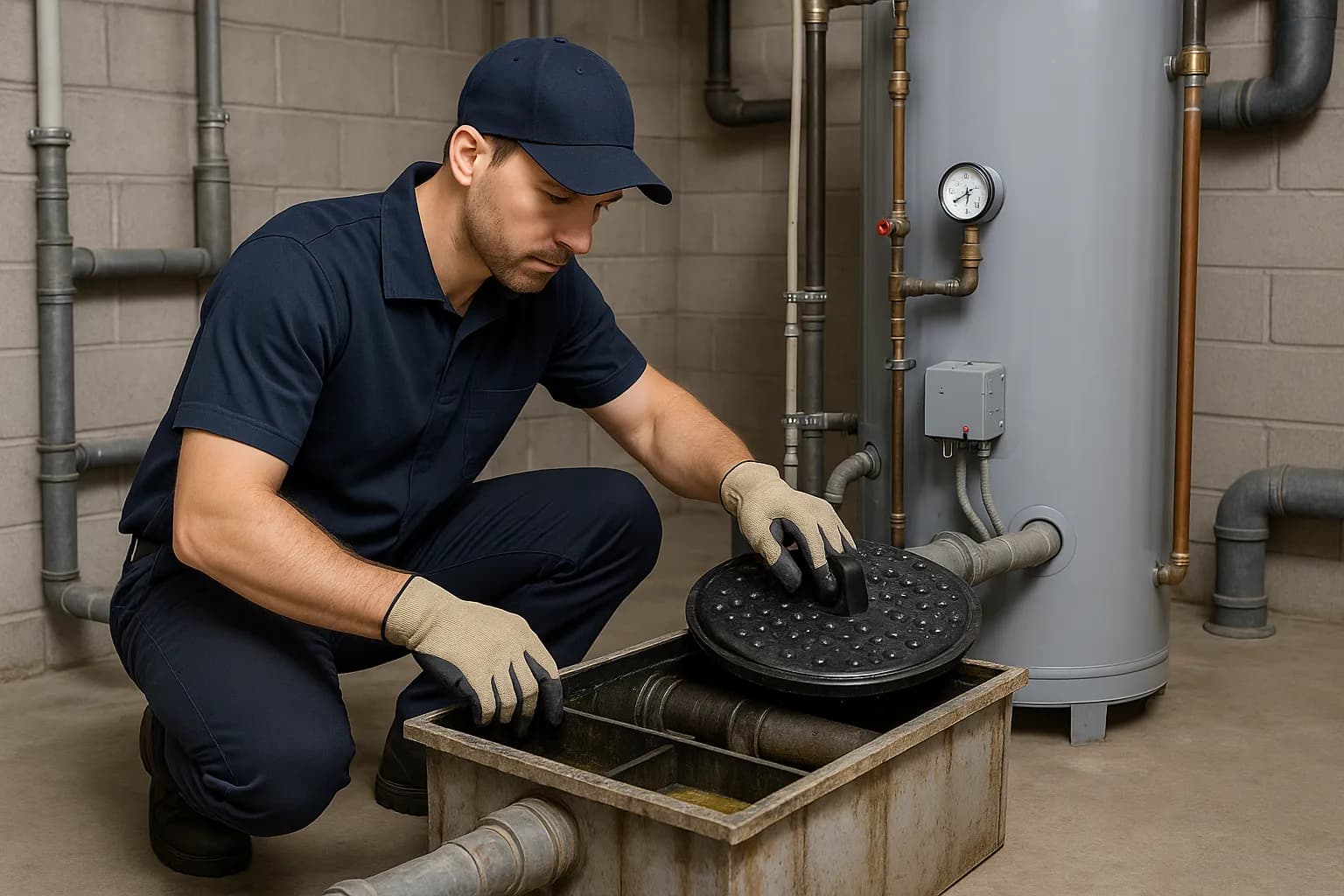
Remove access covers carefully, avoiding damage to gaskets or seating surfaces. Visually inspect for overflow marks, corrosion, broken baffles, and evidence of bypass (grease appearing downstream). This is the point where your vendor should note any structural concerns that may affect drain and sewer performance.[4][5][12]
3. Measure FOG and Solids
Use a sludge judge or calibrated rod to measure the thickness of the floating grease layer and settled solids. Compare these measurements to the trap’s depth to confirm whether you are at or beyond the 25% threshold.[2][3][8][11][15] Recording these values is essential for compliance and for optimizing service frequency.
4. Pump Out Contents
For proper grease trap maintenance, the unit must be fully pumped, not skimmed.[11][12][15] A vacuum truck typically removes the entire contents—floating FOG, settled solids, and gray water. Partial skimming leaves sludge that rapidly reduces capacity and can create odours.
5. Scrape and Brush Interior Surfaces
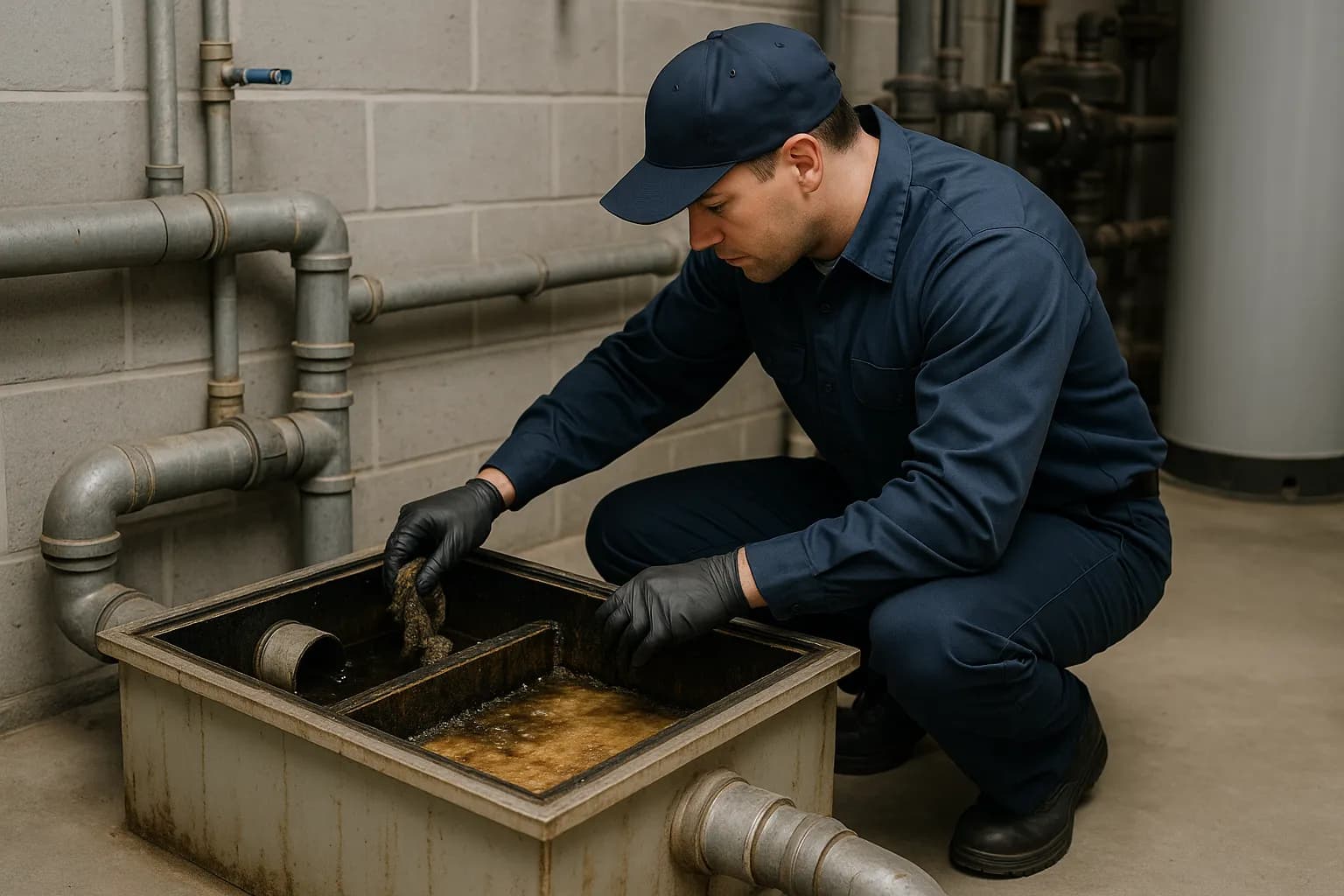
Technicians should scrape walls, baffles, inlets, and outlets to remove hardened grease and solids, then brush surfaces with hot water and appropriate detergents that do not rely on emulsifying agents.[2][5][12] Various FOG programs advise against using caustic drain cleaners or grease dissolvers that simply push suspended grease further downstream, where it can re-solidify.[5]
6. Inspect Components and Flow
Check inlet and outlet tees or baffles, sample ports, and access risers for damage or misalignment. Confirm that flow control devices (for hydro-mechanical traps) are present and unobstructed.[8][9][12] This step ties grease trap maintenance directly into overall drain and sewer health, as damaged baffles can allow grease to escape into building sewers.
7. Reseal and Document
Reseat lids and gaskets carefully to prevent odour leaks and infiltration. Finally, update the grease trap maintenance log with date, time, FOG and solids measurements, disposal manifest number, and technician information.[3][13][14] Many codes require these records to be available during inspections.
Action item for managers: Standardize a written maintenance protocol with your vendor and require manifest copies for all pump-outs. Include grease devices in your CMMS or asset management system with recurring work orders.
Upstream Plumbing Practices That Reduce Grease Trap Load
Grease trap maintenance is more effective when upstream fixtures and staff behaviour support FOG control. Industry guides consistently recommend reducing grease at the source so traps and interceptors are not overloaded between services.[2][4][5][12]
- Mechanical capture at sinks and floors: Install sink strainers and floor drain baskets to catch food solids before they reach the trap.[4][5][12] This protects branch drains and reduces solids settling inside the interceptor.
- Dry scraping and wiping: Require staff to scrape plates, pans, and griddle surfaces into trash and dry-wipe equipment before washing.[2][5][12] This significantly reduces FOG entering the water supply side of the washing process.
- No hot-water flushing of grease: Utilities warn against using very hot water to "push" grease down the drain and against chemical emulsifiers that claim to dissolve grease.[5] These practices move the problem downstream to building sewers and municipal mains.
- Used oil management: Provide covered containers for fryer oil and arrange pickup by an oil recycling or rendering service.[4][5] Pouring oil into sinks or floor drains is a leading cause of interceptor overload and code violations.
- Staff training and signage: Many compliance programs emphasize staff training and simple signage at sinks and dishwash stations to reinforce FOG controls.[2][12]
For facility and property managers, this means grease trap maintenance is not just a vendor task; it requires coordination with tenant operations and clear expectations in lease language around FOG handling and drain use.

Cost, ROI, and Project‑Scale Implications of Grease Trap Maintenance
From a budget perspective, grease trap maintenance is relatively low-cost compared to the potential consequences of neglect. Industry breakdowns indicate typical pump-and-clean pricing includes a base service fee plus a per-gallon charge in the range of roughly $1.00–$1.50 per gallon for commercial grease trap pumping, with disposal charged separately depending on local markets and regulations.[7] Exact pricing varies by region, volume, access complexity, and whether service is scheduled or emergency.
Maintenance vs. repair vs. replacement for managers:
- Preventive maintenance: Routine pump-outs and cleaning prevent blockages, odours, and corrosion. This is usually a predictable operating expense that can be allocated to common area maintenance or passed through to food service tenants.
- Repair: If inspections reveal damaged baffles, corroded lids, or failing risers, targeted repairs are needed to maintain hydraulic performance and prevent bypass into building sewers.[4][9][12] These are modest capital expenses compared to full sewer line rehabilitation.
- Replacement or upsizing: Chronic overload (FOG routinely exceeding 25% well before scheduled cleanings) may indicate that the grease device is undersized for tenant load or not installed per IPC/UPC sizing tables. In this case, replacement with a larger interceptor, additional in-line devices, or reconfiguring kitchen fixtures may be required. While capital-intensive, this often reduces emergency hydro jetting, sewer backups, and noncompliance risk.
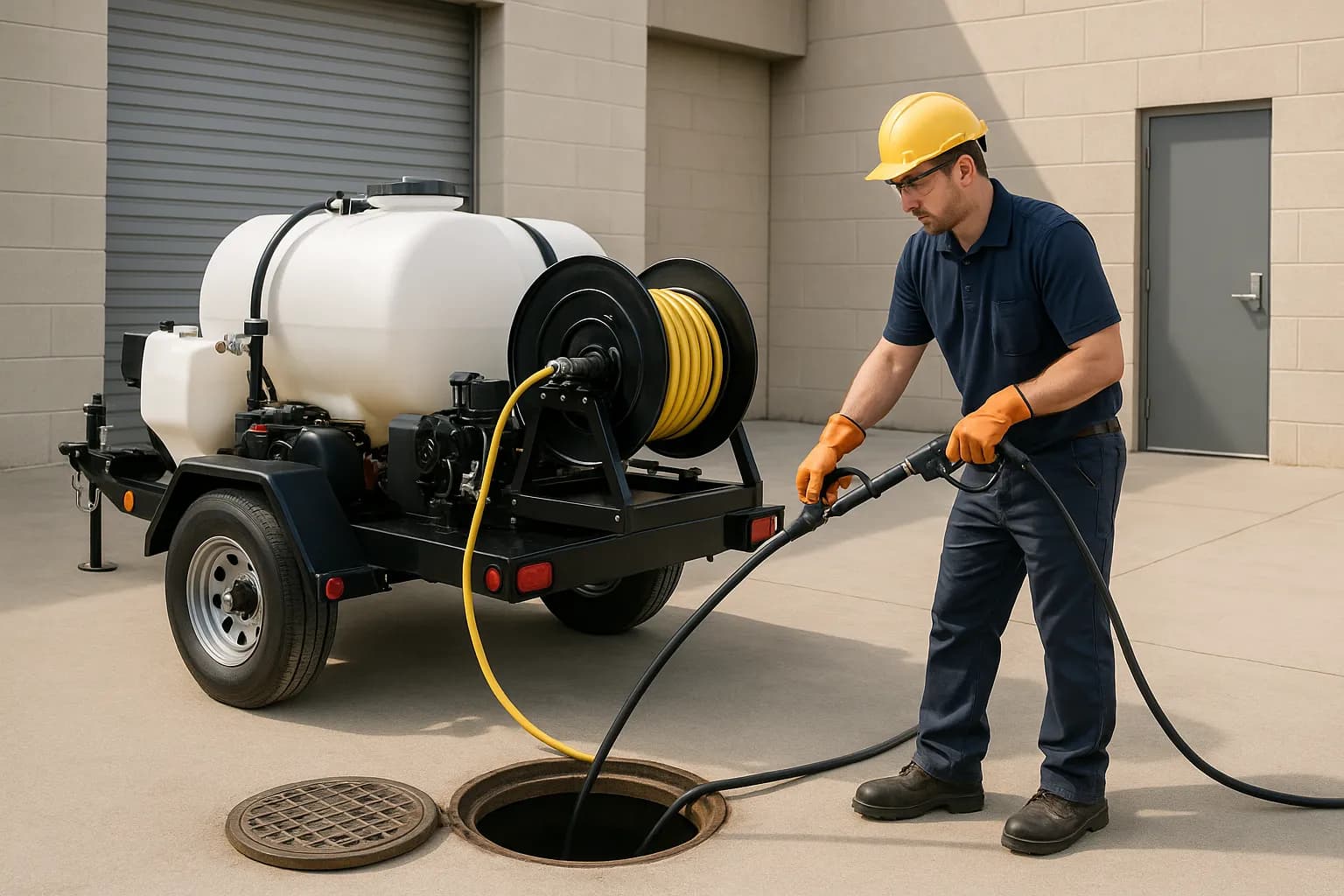
Neglected grease trap maintenance frequently shows up as repeated drain and sewer emergencies: floor drain overflows in kitchens, basement sewer backups, and lift station alarms caused by FOG accumulation. These events require after-hours response, hydro jetting, and sometimes camera inspections and sewer repairs—costs that can quickly exceed years of routine maintenance.
Action item for managers: Compare your annual grease trap maintenance spend with recent emergency drain/sewer invoices. If emergency FOG-related work is high, tightening maintenance intervals or upsizing devices may offer better ROI.
Integrating Grease Trap Maintenance with Broader Plumbing Asset Management
Grease trap maintenance touches several other plumbing systems that facility managers oversee:
- Drain and sewer systems: Properly maintained traps and interceptors dramatically reduce FOG accumulation in branch lines, building sewers, and municipal connections. This can lower the frequency and aggressiveness of hydro jetting and reduce the risk to aging cast iron or PVC lines.
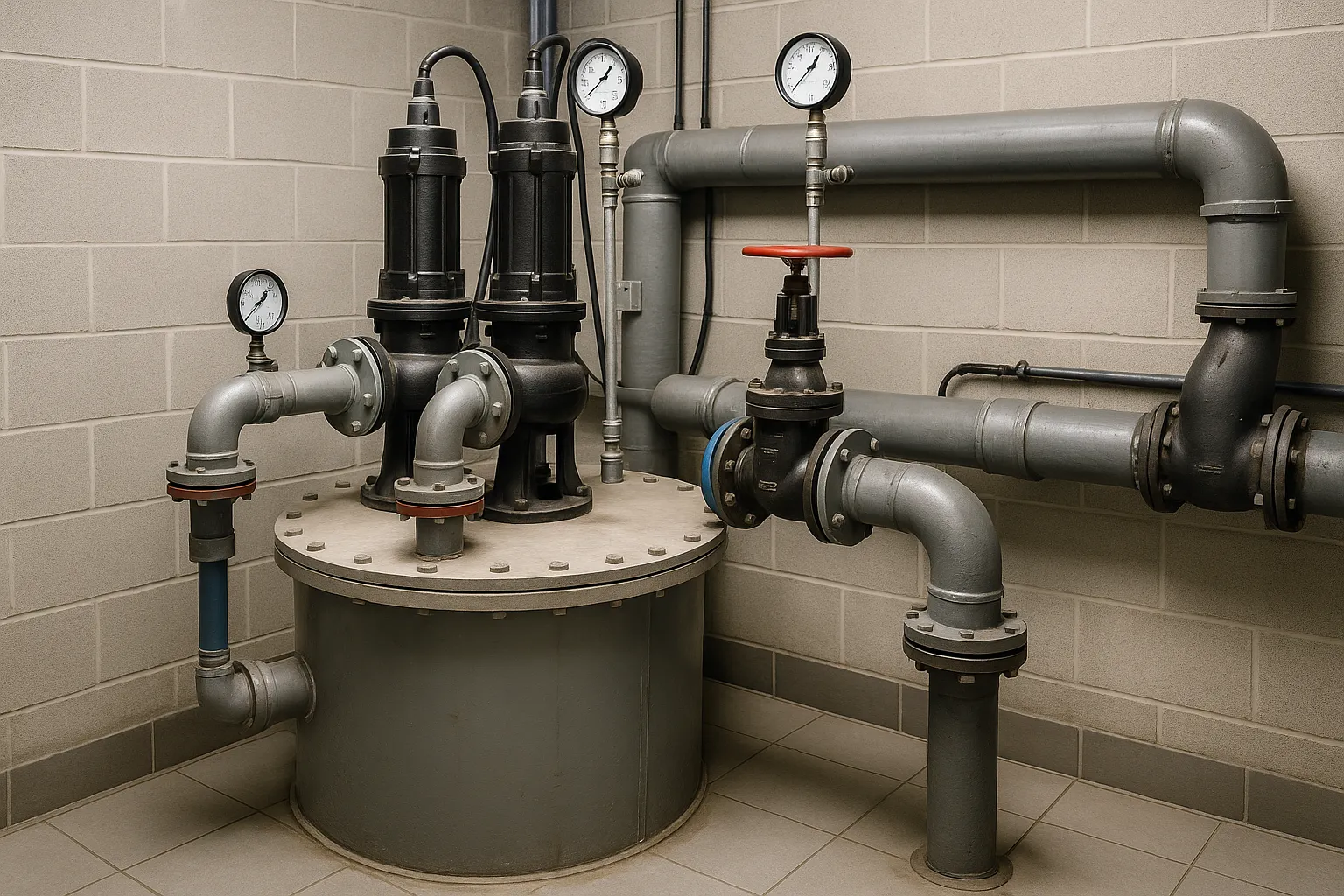
- Lift stations and sump systems: In facilities where kitchen effluent is pumped from lower levels, grease can accumulate on floats, pumps, and wet-well walls. Effective upstream grease trap maintenance protects these mechanical assets and reduces nuisance alarms.
- Backflow prevention: While backflow devices are primarily about cross-connection control in the potable water distribution system, FOG-related overflows can complicate testing and repairs in mechanical rooms by introducing unsanitary conditions. Maintaining interceptors reduces unsanitary spill risk near backflow assemblies.
- Water heaters and supply distribution: Good FOG management keeps dishwashing and cleaning processes more stable, reducing the temptation to overuse very hot water and caustic chemicals to clear lines. This indirectly protects water heaters and distribution piping from extreme thermal and chemical stress.
- Gas piping and kitchen equipment: Reliable grease management supports continuous operation of gas-fired cooking equipment by reducing unscheduled shutdowns and access issues caused by drain emergencies and odours.
For commercial real estate professionals, a mature grease trap maintenance program supports tenant satisfaction, reduces risk to common infrastructure, and positions the property favourably during environmental or health inspections.
Final action items for facility and property managers:
- Map all grease traps and interceptors on the property (including small in-kitchen units and large outdoor tanks).
- Align maintenance frequencies with the 25% rule and local codes (often 4 weeks for traps, 60–90 days for interceptors).[3][8][9][11][15]
- Standardize vendor scopes: full pump-out, interior cleaning, inspection, and log documentation—not simple skimming.
- Integrate FOG source control (strainers, dry scraping, staff training) into tenant requirements.[2][4][5][12]
- Review emergency drain/sewer history annually to adjust grease trap maintenance strategy and, if needed, plan capital upgrades.
Frequently Asked Questions
What are typical costs and ROI for commercial grease trap maintenance?
Commercial grease trap cleaning is often billed as a pump-and-clean fee plus per‑gallon charges, with industry guides citing ranges around $1.00–$1.50 per gallon, plus disposal.[7] Compared to the cost of emergency hydro jetting, sewer repairs, tenant downtime, and potential fines, consistent maintenance delivers strong ROI and more predictable operating expenses.
How does grease trap maintenance support code compliance and reduce enforcement risk?
Many sewer use bylaws and environmental codes require interceptors to be cleaned before grease and solids exceed 25% of volume and set minimum service intervals (e.g., every 4 weeks for traps or 90 days for interceptors).[3][8][11][13][15] Documented grease trap maintenance logs and manifests help facility managers prove compliance and avoid surcharges, penalties, or shutdown orders.
What risks do facility managers face if grease trap maintenance is neglected?
Neglecting grease trap maintenance can lead to recurring drain clogs, basement sewer backups, foul odours, and equipment failures in lift stations and downstream piping.[4][5][9][12] It also increases the likelihood of regulatory citations and higher wastewater surcharges. These risks disrupt tenant operations and can damage the property’s reputation and NOI.
How should property managers coordinate grease trap maintenance across multiple food-service tenants?
Property managers should map all grease devices, set building-wide minimum maintenance intervals aligned with local codes, and require tenants to participate in a shared or coordinated service program.[3][8][9][13] Including FOG handling and maintenance expectations in lease documents ensures consistent standards and simplifies compliance documentation during inspections.
When does a facility need to consider upgrading or replacing a grease interceptor?
If FOG consistently reaches 25% capacity well before scheduled cleanings, or inspections show structural damage, corrosion, or repeated bypass, managers should evaluate sizing and condition against IPC/UPC and local FOG program guidance.[3][9][11][15] Upsizing or replacing the interceptor may reduce emergency sewer work, improve compliance, and better match tenant load.
What should facility managers look for in a grease trap maintenance vendor?
An effective vendor should perform full pump-outs (not skimming), measure and record FOG and solids depth per the 25% rule, clean interior surfaces, inspect baffles and risers, provide disposal manifests, and understand local FOG regulations.[2][10][12][13] Facility managers should favour providers who integrate with their CMMS and offer data for compliance reporting.
Related Reading on My Plumbing Tech
- Colorado Approves Water Demand Calculator for Commercial Water Supply Piping Sizing
- PEX Tubing Standards Advisory: What Facility Managers Need to Know
Find a Qualified Commercial Plumbing Contractor
Need help acting on this? Browse commercial plumbers in your area, or explore commercial plumbing services like preventative maintenance, inspections, and emergency response. Are you a contractor? List your business on My Plumbing Tech to reach property and facility managers actively searching for help.